Blended Learning Model BlueprintPrimary Deliverable · Sample Excerpt
Sample Overview
The blueprint is the engagement's primary deliverable: the connective layer between Van Lang's strategy, its platforms (Brightspace and Workday), and what students actually experience. This page lays out the blueprint's full structure, with a short abstract of what each component does and why it matters, followed by three tangible excerpts that show the level of detail the finished blueprint carries.
Illustrative throughout: the excerpts use a generic 3-credit course and follow international credit-hour conventions. The finished blueprint is calibrated to Van Lang's credit system, academic calendar, and the 2030 target of 50% of learner time delivered online.
The Blueprint
Seven components, designed to fit together. Each is specified to a build-ready level of detail so a team can implement directly from the document.
Learning Experience Architecture
What it does
Defines the standard student journey end to end and how learning time is distributed across in-person, live-online, structured-asynchronous, and independent-practice modalities: the predictable shape every course shares.
Why it matters
Without a shared architecture, every program improvises and "50% online" stays a target rather than a designed experience. This is the foundation every other component builds on, and what keeps the experience consistent across programs and levels.
Course Design Standards
What it does
A build-and-review rubric (benchmarked to Quality Matters, the OLC Quality Scorecard, and the Community of Inquiry framework) that every course passes before launch, covering objectives, assessment alignment, materials, interaction, and technology.
Why it matters
It converts the promise of real, applied learning into something measurable and repeatable across a large, partly-adjunct, partly-remote teaching force. Standards are how quality survives scale.
AI Integration Framework
What it does
Design guidance across three layers: AI-enhanced instruction (faculty), AI-mediated learning (students), and AI-conscious course design (assessment). It also includes an assessment-tiering model and student AI-literacy outcomes.
Why it matters
AI is central to the institution's strategy and to graduates' careers. This makes AI a designed capability rather than an afterthought, and protects academic integrity as AI use becomes universal.
Technology & Platform Operating Model
What it does
Defines how Brightspace (the learning platform) and Workday (the student and operations system) work together: the division of labor, the integration points for enrollment, rostering, grades, and analytics, and the standard Brightspace course template.
Why it matters
The platforms are already chosen; value comes from how they connect and how they are used. This is the "now what" that turns two systems into one operating model. Without it, capable platforms sit underused.
Faculty Development Model
What it does
A faculty readiness pathway, a course-design support workflow, and ongoing communities of practice covering online pedagogy, technology integration, and responsible AI use in teaching.
Why it matters
A delivery model that leans on visiting, adjunct, and online/hybrid instructors only works if those instructors are enabled to teach well online. Faculty development is what de-risks the staffing strategy and keeps quality consistent. How the Center builds this capacity →
Media Production & Content Workflows
What it does
Production standards for instructional video and interactive media, plus a repeatable, scalable content-development pipeline with defined roles and turnaround times.
Why it matters
Serving thousands of learners requires industrialized, consistent production, not artisanal one-offs. Workflows are how content quality and cost stay predictable as volume grows. A talent pipeline from art & design →
Student Support & Success Services
What it does
The student-facing support model for a blended environment: onboarding, advising, proactive early-alert outreach, and help pathways tied directly to the learning architecture.
Why it matters
Attrition is the chief risk in online learning. Proactive support protects completion rates and the premium positioning the model is built to deliver.
The excerpts below sample components 1, 2, and 3.
Excerpt A · Architecture
Excerpt A · Component 1
Learning Time Allocation
Sample: distribution of the 135 total learning hours in a 3-credit course at the 50% blend profile (the 2030 target). The full blueprint also provides 30% and 40% profiles for transitional use, plus the weekly learning cycle and module anatomy standard.
| Modality | Hours / course | ~Hrs / week | What this time is for |
|---|---|---|---|
| In-person sessions | 30 | 2.0 | Discussion, problem-solving, teamwork, coaching: what requires being together. Never first-exposure lecture. |
| Live online sessions | 8 | 0.5 | Guest speakers, exam briefings, cross-section events, scheduled and recorded. |
| Structured asynchronous | 45 | 3.0 | Instructor video, interactive readings, quizzes, discussion forums: designed, sequenced, graded touchpoints. |
| Guided independent practice | 38 | 2.5 | Assignments, AI-assisted practice, peer review, project work, guided by templates and rubrics. |
| Assessment & feedback | 14 | 1.0 | Milestones, capstone, structured reflection. |
| Total | 135 | 9.0 | Online share ~67% of hours; ~50% of instructed time. |
Allocation rule (sample): each modality must do what only it can do. If an in-person session could be a video, it becomes a video; if an online activity needs live negotiation, it moves into the room. Weekly workload is calculated during design and printed on every module page so students always know the expected hours.
The Architecture in Action: A Case-Method Class
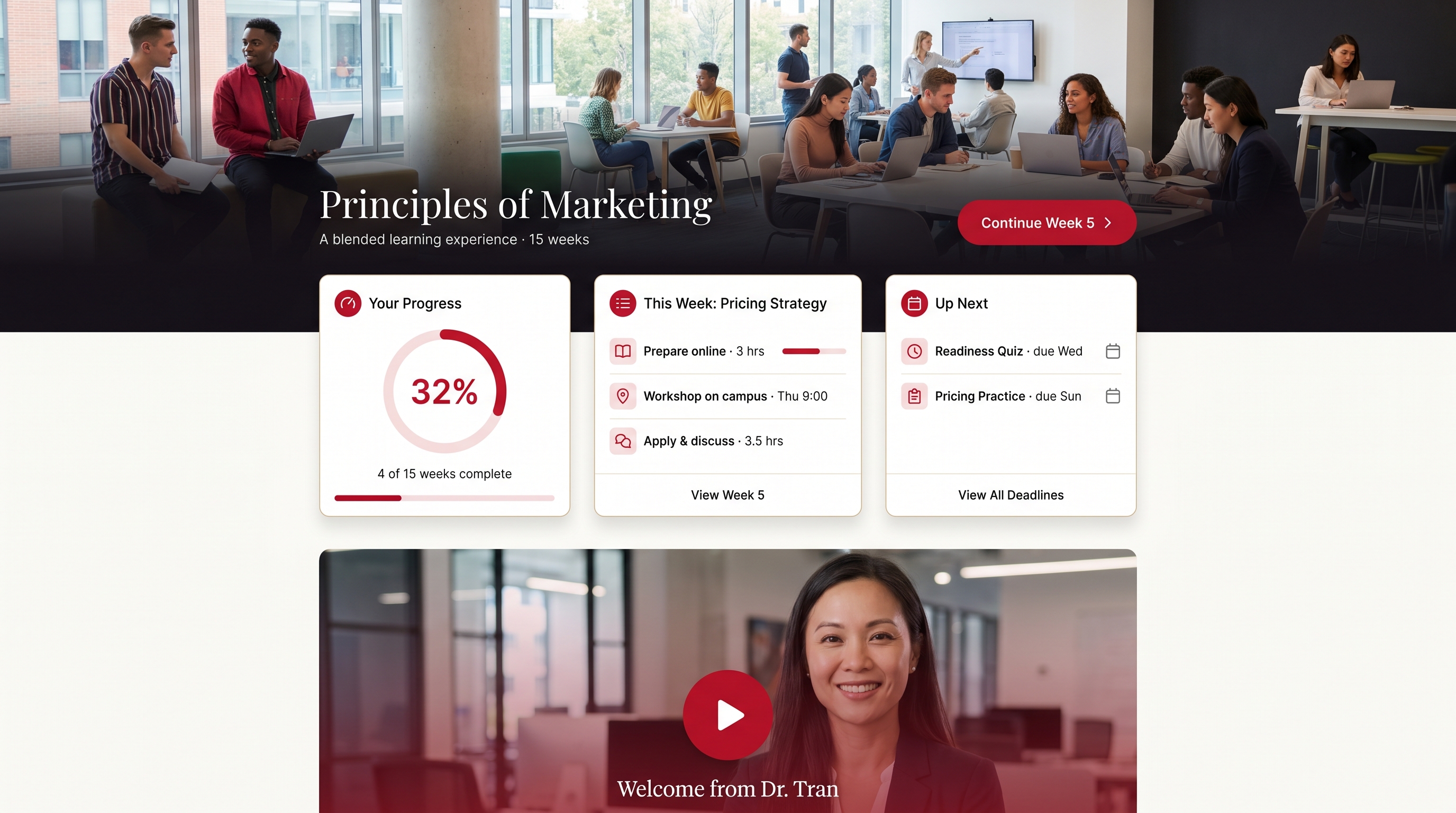
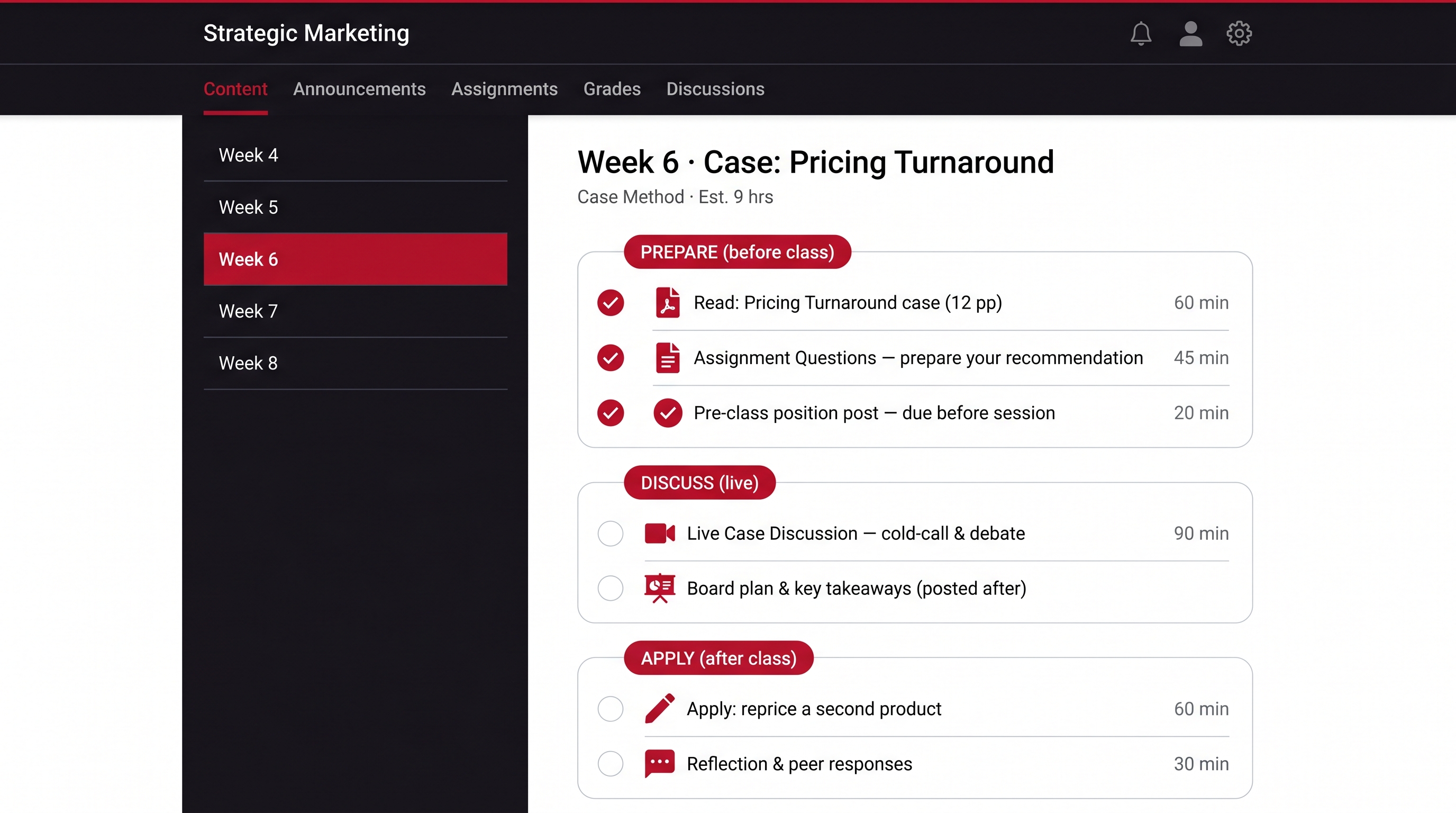
The allocation model above is the framework; this is what it looks like in a real course. The example traces one high-value archetype, a Harvard-style case-method class blended with Stanford d.school project-based learning, from pedagogical intent, to course-design decision, to the actual build in Brightspace. The same method produces a build pattern for every course archetype in the model.
The pedagogy. The case method only works if students arrive prepared and do the thinking themselves: read the case, take a position, then defend and refine it in live discussion. Project-based learning extends this: students don't just analyze one case, they apply the concept to a new problem and iterate. The design challenge is to protect that pedagogy inside a blended format where much of the work happens online.
| Pedagogical move | Course-design decision | How it is built in Brightspace |
|---|---|---|
| Advance preparation: students arrive ready to contribute | Prepare phase: case reading, assignment questions, and a graded pre-class position post that must be submitted before the session | A Content module holds the case PDF and question set; a Discussion topic collects position posts with a due date set before the live session; release conditions keep the discussion focused on those who prepared |
| Cold-call discussion: equitable, high-stakes participation | Discuss phase: instructor-guided live session built on carefully sequenced questions, with participation tracked across the term | A virtual-classroom link (Zoom/Teams) sits in the module; a participation rubric lives in the gradebook; the session is recorded and posted back for review |
| Synthesis: the instructor's board plan captures the argument | Debrief: key takeaways and the board capture are shared after class so learning is consolidated, not lost | The board image and a short takeaways page are posted to the module; an announcement notifies students and links forward to the application task |
| Transfer & iteration (PBL): apply the concept to a new problem | Apply phase: a scenario assignment asks students to act on the concept in a fresh situation, with an AI-assisted practice option and a design-thinking iterate-and-revise loop | An assignment with an attached rubric; an AI-practice activity following the AI Integration Framework (see Excerpt C); optional resubmission enabled for the revise cycle |
| Reflection & peer learning: consolidate and learn from others | Reflection: a structured prompt with a defined post-by / respond-by rhythm | A Discussion topic with interaction requirements and dates; completion tracking surfaces who is keeping pace |
The project-based variant. For a studio or project course, the same architecture flexes: the single case discussion becomes a multi-week arc following the Stanford d.school phases (Empathize, Define, Ideate, Prototype, Test), with each phase a module and a live critique session, and the final deliverable replacing the exam. One architecture, two recognizable course archetypes.
Excerpt B · Standards
Excerpt B · Component 2
Course Design Standards
Sample: 4 of approximately 40 standards in the full rubric. Each course is reviewed against the rubric before launch; every standard includes reviewer guidance and an example of what "Met" looks like in practice.
| # | Standard | Benchmark | Rating |
|---|---|---|---|
| 2.1 | Module-level objectives are measurable and visibly aligned to assessments and activities | QM 2.2 / 2.4 | Met / Partial / Not met |
| 3.2 | Online and in-person components form one coherent sequence, with the relationship made explicit to students | OLC Blended Scorecard | Met / Partial / Not met |
| 4.3 | Learners interact with instructor and peers in structured, purposeful ways each week | CoI · Social presence | Met / Partial / Not met |
| 6.1 | Course policies state permitted and prohibited AI use per assessment, with rationale students can understand | AI Integration Framework | Met / Partial / Not met |
Excerpt C · AI Framework
Excerpt C · Component 3
AI Integration Framework
Sample: one row from each of the framework's three layers, applied to the example course. Student AI-literacy outcomes are embedded across all three and mapped in full.
| Layer | Design question | Sample guidance |
|---|---|---|
| AI-enhanced instruction (faculty-facing) | How can instructors use AI to improve course quality and responsiveness? | Generate differentiated practice-question banks from course materials; instructor reviews and approves before release. Prompt templates and a review checklist provided. |
| AI-mediated learning (student-facing) | Where does AI become part of the learning activity itself? | Students draft an analysis, then critique an AI-generated version of the same task, building both domain skill and AI-evaluation skill. Activity template provided. |
| AI-conscious design (assessment) | How must assessment change when students have AI access? | Classify each assessment into three tiers (AI-prohibited, AI-permitted, AI-required), with redesign patterns and a decision tree for existing assessments. |
End of sample. The full blueprint delivers all seven components at this level of specificity, calibrated to Van Lang Global School and the 2030 vision. See the Future-Ready Blended Learning proposal for the complete engagement scope, or the Center of Teaching and Learning sample for the unit that owns this model and builds the capacity to deliver it.