M Minh Le.

Future-Ready Blended Learning ModelFramework, Pilot Plan, and Strategic Outlook

01

Project Overview

Van Lang University has set a clear institutional direction. Its 2030 strategy commits the university to expanding its postgraduate portfolio around four interdisciplinary flagships, in business, finance, communications, and applied AI, and to delivering a growing share of learning, with a target of at least 50% of learner time, through online and personalized formats. That ambition reaches beyond graduate study to undergraduate and lifelong learning: widening access to high-quality teaching at scale, optimizing how and when students learn, and building pathways to study at leading global institutions.

Van Lang's strategy is explicit on one point: a world-class partnership requires a world-class infrastructure. That is why the university has invested in its core platforms, selecting D2L Brightspace as its learning platform and Workday as its student and operations system. Technology, though, is only the vehicle. What runs it is the operating system around it: the learning model, course standards, and faculty capability that decide what students actually experience inside the platform. A platform is put to work by people, and it is that human capacity that converts the investment into results.

Delivering that world-class operating system, and building the human capacity to run it, is the focus of this engagement. It is the layer between the strategy and the technology, and it is what makes the rest of the plan deliverable. In practice, it equips the foundation workstream of the strategy's first-90-days plan, building core capability (Luồng 2 · Nền tảng · Dựng năng lực lõi): configuring the learning platform for hybrid and distance delivery, planning faculty readiness, and standing up the course-development capability the flagship programs will rely on.

Van Lang Global School will serve as the proving ground. A focused pilot lets the university define standards, build institutional capacity, and validate the model before scaling it across priority programs and ultimately, across the full learner journey from undergraduate to executive and lifelong education.

This engagement delivers that foundational model, benchmarked against international standards for online learning quality, with each component specified to the level of detail a team needs to build from, and with explicit attention to how technology and AI strengthen pedagogy, deepen learning, and prepare students and faculty for a world in which AI is a constant presence in professional and academic life.

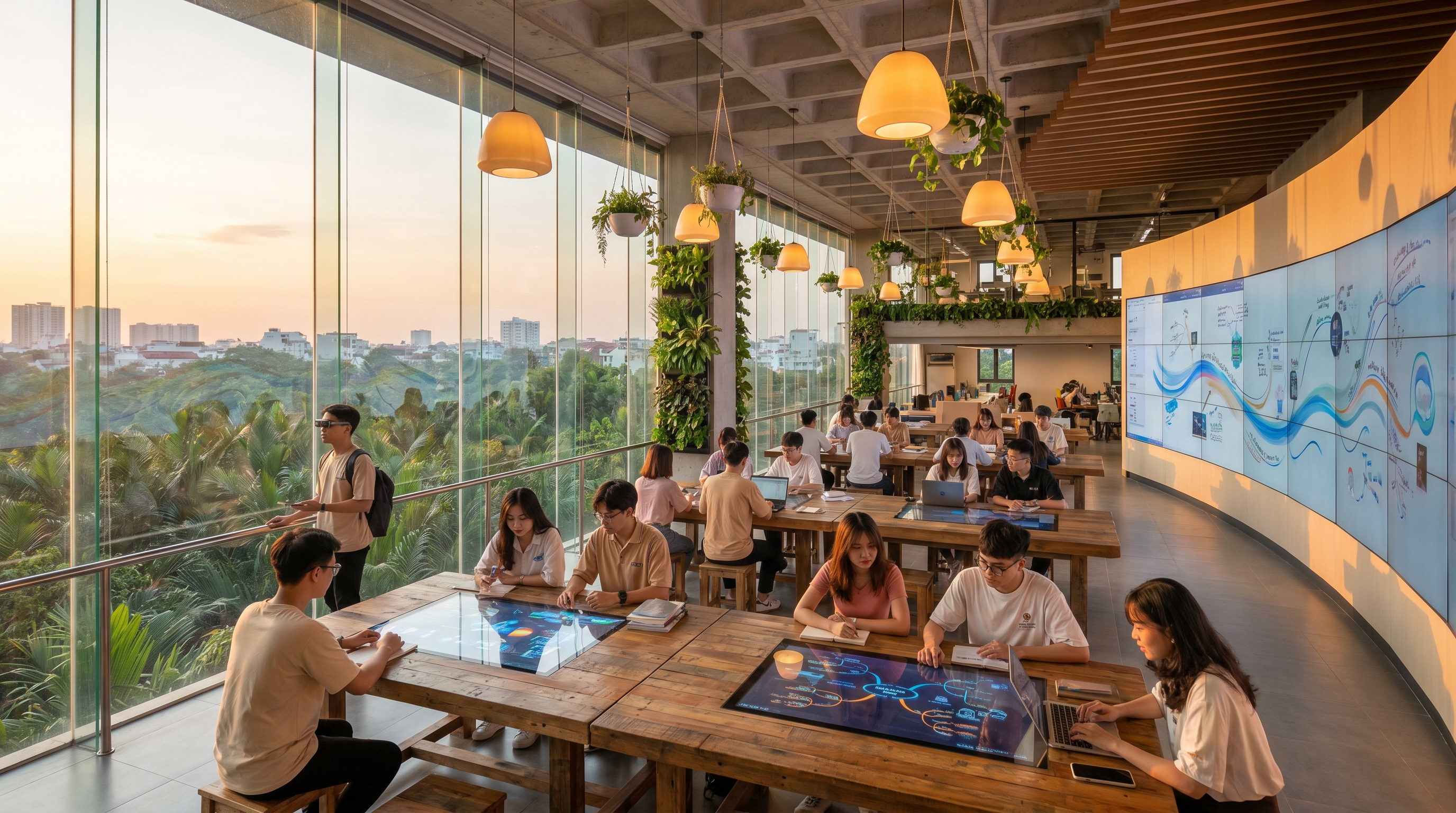
Faculty and students collaborating around immersive learning technology Leading the Future of Teaching and Learning
02

Objectives

  1. Design a foundational blended learning model benchmarked against Quality Matters (QM), the OLC Quality Scorecard, and the Community of Inquiry (CoI) framework, addressing five quality dimensions: learning effectiveness, learner experience, instructor experience, scale, and access.
  2. Turn the existing platform investment into an operating model: define how Brightspace and Workday work together to deliver, track, and support learning, so the technology already in place produces a coherent student and faculty experience.
  3. Integrate technology into teaching as a design priority: how faculty use digital tools to enhance pedagogy, facilitate active learning, and create engaging experiences online and in person.
  4. Build an AI integration framework spanning AI-enhanced instruction, AI-mediated learning activities, and AI-conscious course design, including student AI literacy and responsible use.
  5. Specify every model component to a build-ready level of detail: learning experience architecture, course design standards, faculty training, media production, student support, and operational infrastructure.
  6. Recommend a Center of Teaching and Learning as the institutional home for the model (structure, key roles, and governance), designed as a shared capability serving programs from undergraduate to executive and lifelong learning.
  7. Deliver an implementation-ready pilot plan for Van Lang Global School, with a phased roadmap to scale from the pilot to priority clusters, beginning with business/management and technology.
  8. Provide a Strategic Outlook toward 2030 (micro-credentials, AI-era pedagogy, and lifelong learning) as a longer-range institutional reference.
03

Scope of Work

Phase 1 Vision Alignment and Model Specification
  • Align on Van Lang's vision and define model specifications for Van Lang Global School.
  • Assess the current state of technology infrastructure, faculty readiness, and pedagogical practice to establish a baseline for the model.
  • Define key indicators of success and measurable outcomes for the pilot, aligned with institutional goals and applicable regulations.
  • Scope the pilot cohort: target programs, student population, and implementation timeline.
Phase 2 Blended Learning Model Design
  • Design a foundational blended learning model establishing Van Lang's standard for online learning excellence, benchmarked against Quality Matters (QM), the OLC Quality Scorecard for Blended Learning, and the Community of Inquiry (CoI) framework. The model addresses five quality dimensions: learning effectiveness, learner experience, instructor experience, scale, and access, with a data-informed quality improvement loop built in from the start.
  • Address technology integration into teaching and learning as a core design dimension: how faculty use digital tools, collaborative platforms, and active learning technologies to enhance pedagogy in online, in-person, and blended settings.
  • Design an AI integration framework for the model: AI-enhanced instruction (using AI tools to support delivery and personalization), AI-mediated learning activities (adaptive practice, AI-assisted feedback), and AI-conscious course design (ethical use of AI, developing student AI literacy aligned with QM's AI Integration Toolkit).
  • Define the online learning experience architecture: what the standard student journey looks like and how learning time is structured across modalities.
  • Develop course design templates and quality standards aligned with QM's 8 General Standards, covering learning objectives, assessment alignment, instructional materials, learner interaction, and course technology.
  • Design a faculty training and development program covering online pedagogy, technology integration, and responsible AI use in teaching.
  • Establish media production requirements and scalable content development workflows.
  • Define student support and advising services for learners in a blended environment.
  • Design the operational infrastructure required to sustain the model, including technology stack integration and the organizational model for a Center of Teaching and Learning.
Phase 3 Pilot Plan, Roadmap, and Deliverable
  • Develop a detailed implementation plan for Van Lang Global School as the pilot vehicle.
  • Provide organizational recommendations for establishing a Center of Teaching and Learning: structure, key roles, staffing, and reporting lines.
  • Develop a phased scaling roadmap from Van Lang Global School to priority programs, beginning with business/management and technology clusters.
  • Final deliverable: a comprehensive, implementation-ready blueprint covering the model design, AI integration framework, pilot plan, organizational recommendations, and scaling roadmap.
  • Present the full deliverable package to Van Lang leadership in an executive capstone briefing (live or virtual), with time for discussion and next-step alignment.
Phase 4 Strategic Outlook Toward 2030
  • Trends shaping higher education: blended and personalized learning, AI in teaching and assessment, and the evolving role of the university.
  • The micro-credential and lifelong learning opportunity: what leading institutions are doing and where Vietnam is heading.
  • Recommendations for Van Lang's long-term positioning as a destination for workforce development, upskilling, and continuous learning.
  • Included as a strategic appendix to the final deliverable; not a separate project phase.
04

Deliverables

  • Implementation-ready blended learning model blueprint (primary deliverable): learning experience architecture, course design standards, AI integration framework, and the platform operating model for how Brightspace and Workday work together.
  • Van Lang Global School pilot implementation plan.
  • Center of Teaching and Learning organizational recommendation: structure, roles, and governance.
  • Phased scaling roadmap from the pilot to priority clusters, beginning with business/management and technology.
  • Strategic Outlook 2030 appendix: micro-credentials, AI-era pedagogy, and lifelong learning.
  • Executive capstone briefing: a leadership presentation (delivered live or virtually) synthesizing the complete deliverable set (model blueprint, pilot plan, organizational recommendations, scaling roadmap, and Strategic Outlook 2030) with structured time for stakeholder discussion and next-step alignment.

See what the deliverables look like

Two sample excerpts show the depth and format of the finished work.

05

Timeline and
Project Team

Project Timeline
4 to 6 weeks From project commencement
Estimated Effort
70 to 90 hours Across all phases
Project Lead
Minh Le Principal Instructional Designer, Teachers College, Columbia University

Project Advisor

Shu-Yi Hsu, Ed.D.

Senior Instructional Designer | Learning Experience Strategy & AI-Enhanced Learning
Former: Associate Director of Online Learning and Adjunct Assistant Professor
ExpertiseAI in Education · Online Learning Design · MOOCs · Learning Experience Research · Instructional Technology

Yoo Kyung Chang, Ph.D.

Clinical Professor and Academic Director, Information Systems and Technology
New York University, School of Professional Studies
Previously: Senior Lecturer, Communication, Media, and Learning Technologies Design, Teachers College, Columbia University
ExpertiseApplied Learning Pedagogy · AI in Education · EdTech · Data-Driven Design · Game-Based Learning · Media Literacy

Roxanne Russell, Ph.D.

Assistant Dean, Digital Learning · Adjunct Assistant Professor, Health Policy and Management · Columbia University
Former: Director of Digital Learning, Emory University
ExpertiseOnline Learning Strategy · Instructional Design · DEI in Digital Learning · Learning Analytics · Design-Based Research

Detra M. Price, Ph.D.

Executive Director, Center for Digital Learning and Innovation · Professor of Teaching and Learning · The Ohio State University
President-Elect, National Council of Teachers of English (NCTE)
Former: Associate Professor, Teachers College, Columbia University
ExpertiseDigital Learning · AI Integration in Education · Curriculum Development · Equity-Oriented Pedagogy · K-16 Innovation

06

Investment

Description
Fee (USD)
Total Project Fee Option to extend into an implementation support phase upon project completion
$15,000

Payment terms 50% upon project commencement, 50% upon delivery of the final deliverable.

07

Terms and Conditions

  • This proposal is valid for 30 days from the date of issue.
  • Scope changes requested after project commencement may be subject to additional fees; any changes will be agreed upon in writing before work proceeds.
  • Van Lang University will provide timely access to relevant stakeholders, institutional documents, and decisions (e.g., LMS selection, pilot program list) needed to complete the model design.
  • All frameworks, models, and deliverables produced under this engagement are for Van Lang University's internal use. Minh Le retains the right to reference the engagement in a general professional capacity without disclosing proprietary institutional details.
  • Either party may terminate the engagement with 7 days written notice; work completed to that point will be billed at the agreed rate.